> For the complete documentation index, see [llms.txt](https://ed.sunbird.org/llms.txt). Markdown versions of documentation pages are available by appending `.md` to page URLs; this page is available as [Markdown](https://ed.sunbird.org/release-6.0.0/use/getting-started/deployment-overview.md).
# Deployment Overview
Sunbird ED is a cloud-agnostic platform that can be deployed on a variety of cloud platforms, including Azure, Amazon Web Services (AWS), Google Cloud Platform (GCP) and OCI. The most common deployment architecture is to use a cloud-based platform, as it offers a number of advantages, such as scalability, reliability, and maintainability.
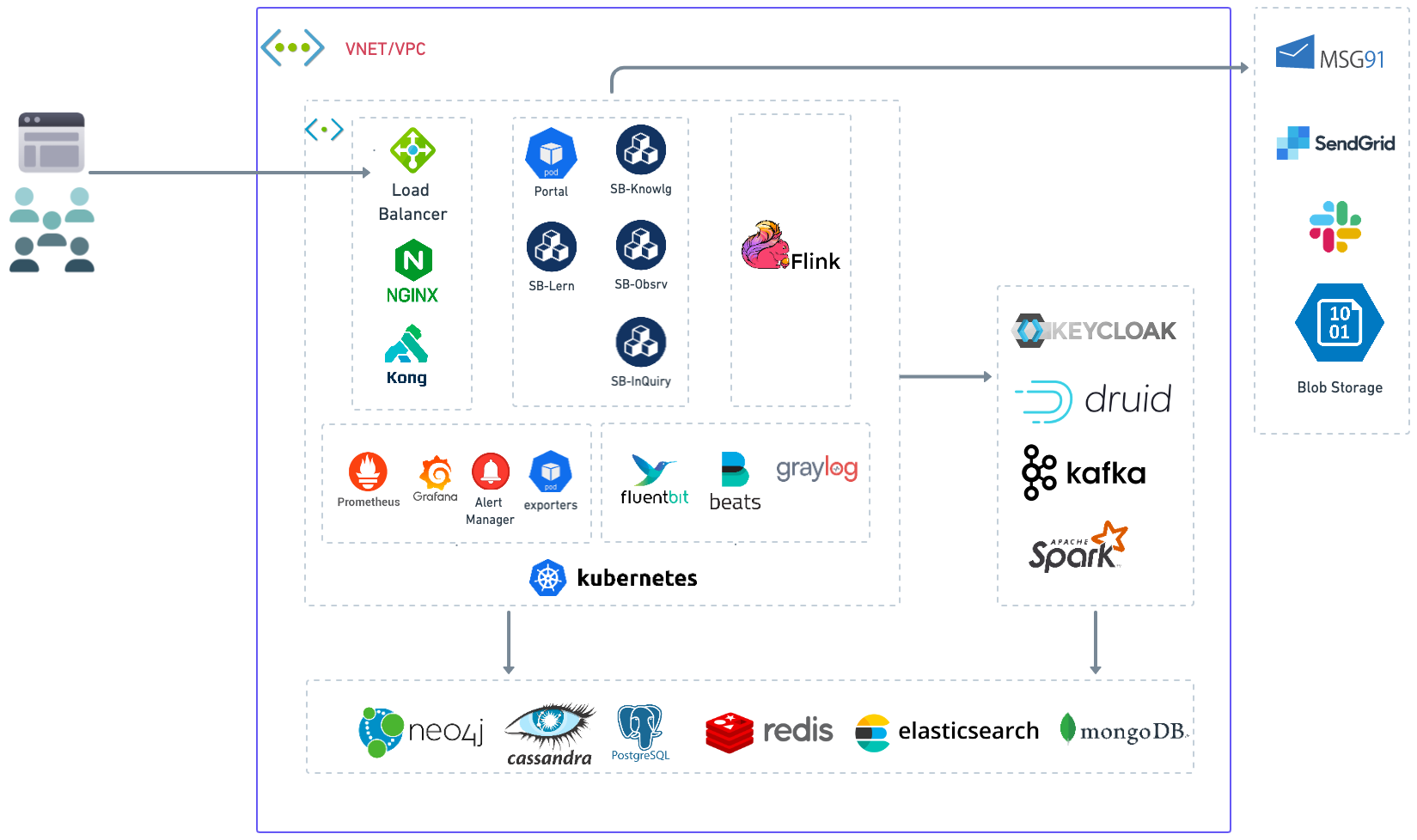
Following diagram depicts the high-level deployment architecture of SunbirdEd platform.
The ideal network configuration depends on the quantity of environments you wish to establish. It is advisable to create a corresponding number of virtual cloud networks, each paired with an administrative virtual network. Within each virtual network, there should be a robust bastion host dedicated to SSH access and a CI slave responsible for code deployment. The administrative virtual network, on the other hand, serves as the central hub for essential utility services, including the CI master server and VPN server etc.
Within each virtual network in every environment, there are several distinct subnets, each assigned specific roles for hosting various types of workloads. These roles typically include administrative tasks, containerised and non-containerised applications, and data workloads. To ensure the secure flow of data, the ingress and egress of data between subnets and servers are meticulously controlled by implementing network security groups.
**Note**: Azure cloud specific resource icons are used in the above diagrams for representation purpose only. However the equivalent resource/service can be used in the other cloud service providers based on your choice
---
# Agent Instructions
This documentation is published with GitBook. GitBook is the documentation platform designed so that both humans and AI agents can read, navigate, and reason over technical content effectively. Learn more at gitbook.com.
## Querying This Documentation
If you need additional information that is not directly available in this page, you can query the documentation by asking a question.
Perform an HTTP GET request on the following URL with the `ask` and `goal` query parameters:
```
GET https://ed.sunbird.org/release-6.0.0/use/getting-started/deployment-overview.md?ask=&goal=
```
`ask` is the immediate question: it should be specific, self-contained, and written in natural language.
`goal` is what the user is ultimately trying to achieve, the reason they need the answer. Sharing it helps GitBook give you a better, more relevant answer. A goal is most helpful when it describes the outcome the user wants rather than restating the question. For example, with `ask=how do I create an API token`, a goal like `automate deployments from our CI pipeline` lets GitBook tailor the answer to that use case.
The response will contain a direct answer to the question and relevant excerpts and sources from the documentation.
Use this mechanism when the answer is not explicitly present in the current page, you need clarification or additional context, or you want to retrieve related documentation sections.